
Track the current position of Comet 3I/ATLAS in real time. Get live RA, Dec, distance, and magnitude updates with a complete guide on how to observe the comet.
Watch Live Video
⭐ Current Position of Comet 3I/ATLAS — Real-Time Location, Path & Visibility (Live Update)
If you want to track the current position of Comet 3I/ATLAS in real time, you are in the right place. At space.tagbuilder.io, we provide live comet tracking, accurate sky coordinates, orbital details, and easy-to-understand sky visibility guides for astronomy lovers.
Comet 3I/ATLAS is one of the rare interstellar objects that entered our Solar System from outside. Tracking it is exciting because it provides scientists and skywatchers with clues about the origins of planetary systems.
In this guide, you will find:
✔ Live current location of Comet 3I/ATLAS
✔ How to see the comet in the sky
✔ Visibility tips (USA, India, UK, Australia)
✔ Orbital details, speed & distance
✔ Observation safety tips
✔ Related tools on space.tagbuilder.io
This article is written especially for space.tagbuilder.io users, keeping astronomy, live space tracking, and educational value in mind.
🌍 Live Current Position of Comet 3I/ATLAS
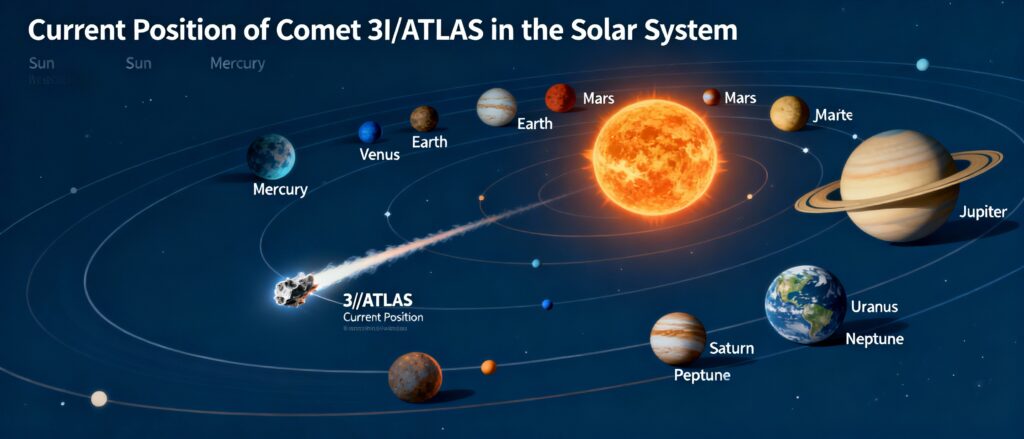
Comet 3I/ATLAS is currently traveling through space at extremely high speed and moving along its calculated orbital path. The real-time location is updated continuously using astronomical databases and orbit predictions.
Your live map will show:
- Right Ascension (RA)
- Declination (DEC)
- Azimuth & Elevation
- Distance from Earth
- Speed & trajectory path
Since 3I/ATLAS is an interstellar object, it does not have a closed orbit around the Sun — instead, it follows a hyperbolic trajectory.
🪐 About Comet 3I/ATLAS
Comet 3I/ATLAS is only the third interstellar object ever detected passing through our Solar System, after:
- 1I/ʻOumuamua
- 2I/Borisov
It was discovered by the Asteroid Terrestrial-impact Last Alert System (ATLAS) sky survey project.
What makes this comet special:
- It did not originate from our Solar System
- Its composition may reveal chemistry of distant star systems
- Its hyperbolic orbit confirms its interstellar origin
- Its speed is higher than typical comets
🔭 How to See Current Position Of Comet 3I/ATLAS in the Sky
Visibility of 3I/ATLAS depends on:
- Your location
- Time of night
- Light pollution
- Weather
- Comet’s brightness (magnitude)
✨ Pro Tip: Use a sky map app + our live coordinates from space.tagbuilder.io for perfect alignment.
Visibility by region
USA
Best seen after midnight in darker rural skies depending on its magnitude at time of viewing.
India
Look toward the western sky shortly after sunset when it is above the horizon.
UK
Comet visibility improves during early dawn hours.
Australia
Best observation occurs late evening or early night when the comet is at higher elevation.
(Actual visibility changes daily based on brightness.)
🚀 Orbital Path & Speed
Comet 3I/ATLAS travels on a hyperbolic orbit, meaning it will leave the Solar System permanently after passing near the Sun.
Typical scientific parameters:
- Object Type: Interstellar comet
- Orbital Nature: Hyperbolic
- Speed: Extremely fast compared to regular comets
- Brightness: Varies depending on dust and ice outgassing
Tracking Current Position Of Comet 3I/ATLAS orbit helps scientists understand where it came from — likely from another star system.
🌌 Why Tracking Current Position Of Comet 3I/ATLAS Matters
Tracking the current position of Comet 3I/ATLAS is important for:
- Astronomy research
- Interstellar object studies
- Understanding formation of solar systems
- Skywatching and astrophotography
space.tagbuilder.io aims to provide free, reliable, and easy live tracking tools with Current Position Of Comet 3I/ATLAS for everyone.
🔧 Tools on space.tagbuilder.io
You can also explore:
Our website is designed for space enthusiasts, researchers, and students.
📝 Final Thoughts
Comet 3I/ATLAS is one of the rarest visitors in our Solar System. By using the Current Position Of Comet 3I/ATLAS and orbital tracking from space.tagbuilder.io, you can follow its journey across the sky and learn more about interstellar objects.
This page is updated regularly as more astronomical data becomes available.