

Lion’s Head Nebula observations captured by the James Webb Space Telescope offer a fresh, detailed look at the final stages of a star’s lifecycle. Released on August 26, 2026, as NASA’s Astronomy Picture of the Day, the new view of NGC 2392 provides critical clues about how dying stars disperse material into the surrounding space, offering a preview of what could eventually happen to our own Sun.
Webb’s Dual Instruments Reveal the Lion’s Head Nebula
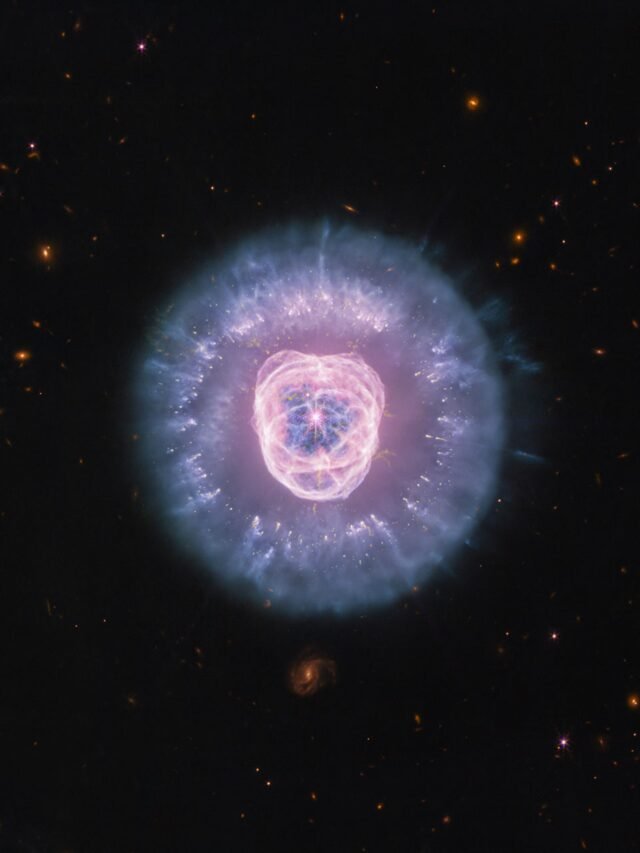
The stellar snapshot is a composite produced using data from Webb’s Near-Infrared Camera (NIRCam) and Mid-Infrared Instrument (MIRI). By blending wavelengths across infrared light, the combined image reveals intricate physical details of NGC 2392 that were previously difficult to resolve.
At the center of the nebula sits a white dwarf, the intense stellar remnant left behind after a Sun-like star ran out of core nuclear fusion fuel. Unable to remain stable, the star began expelling its outer layers of dust and gas into space, forming the expanding structure seen today.
How Stellar Radiation Shapes the Facial Structures
Energetic radiation emanating from the central white dwarf ionizes the surrounding expanding gas, creating the distinct irregular bubble that resembles a face. Meanwhile, resilient clumps of dust that managed to survive the harsh stellar radiation mingle with ionized gas clouds to construct the surrounding mane-like halo.
Astronomers plan to analyze this upgraded dataset to better understand how radiation from white dwarfs interacts with surrounding gas and dust. While the portrait provides an extraordinary look at stellar evolution, researchers continue to study the exact timelines and mechanisms governing how gas and dust mingle as planetary nebulae expand outward.