

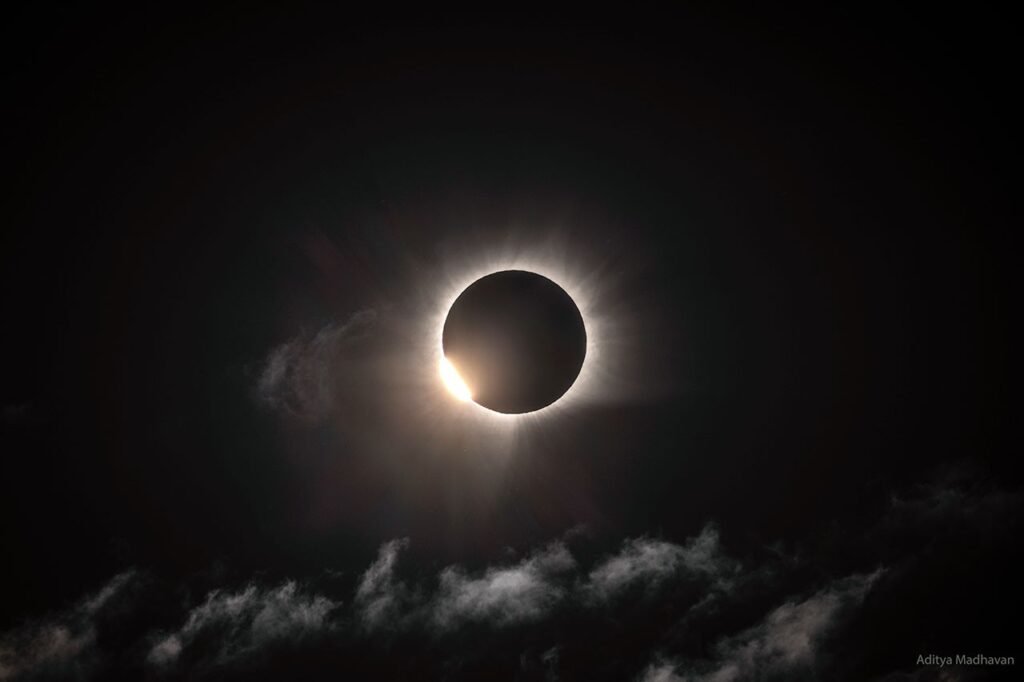
Greenland solar eclipse — The Greenland solar eclipse was captured from a remote coastal fjord on August 12, 2026, offering one of the first unobstructed views of totality from the region. Observers aboard a sea vessel maneuvered along the eastern coast of Greenland to evade overcast conditions, eventually making landfall at Rype Fjord to record the fleeting cosmic alignment. The resulting photograph recorded the Moon fully covering the Sun, revealing the glowing solar corona and a bright diamond ring through a timely break in the cloud cover.
Chasing the Shadow to Rype Fjord
On August 12, the dark lunar umbra touched down in the Arctic Ocean and swept along a narrow path across Greenland, Iceland, the Atlantic Ocean, Portugal, and northern Spain. Observers positioned directly inside this pathway experienced complete daytime darkness as the Moon passed between Earth and the Sun.
To avoid dense coastal clouds, the visual team navigated by sea to reach coordinates 71.07055 North, 27.71252 West along Rype Fjord. At 17:33:26 UTC, a clearing in the skies allowed the team to capture the image just as totality was taking hold.
Observing the Greenland Solar Eclipse Corona
The captured snapshot provides a clear look at two prominent phenomena associated with total solar eclipses: the diamond ring effect and the delicate solar corona. The diamond ring occurs when a final burst of sunlight glimmers through a lunar valley, while the corona forms an expansive atmosphere of plasma surrounding the dark lunar silhouette.
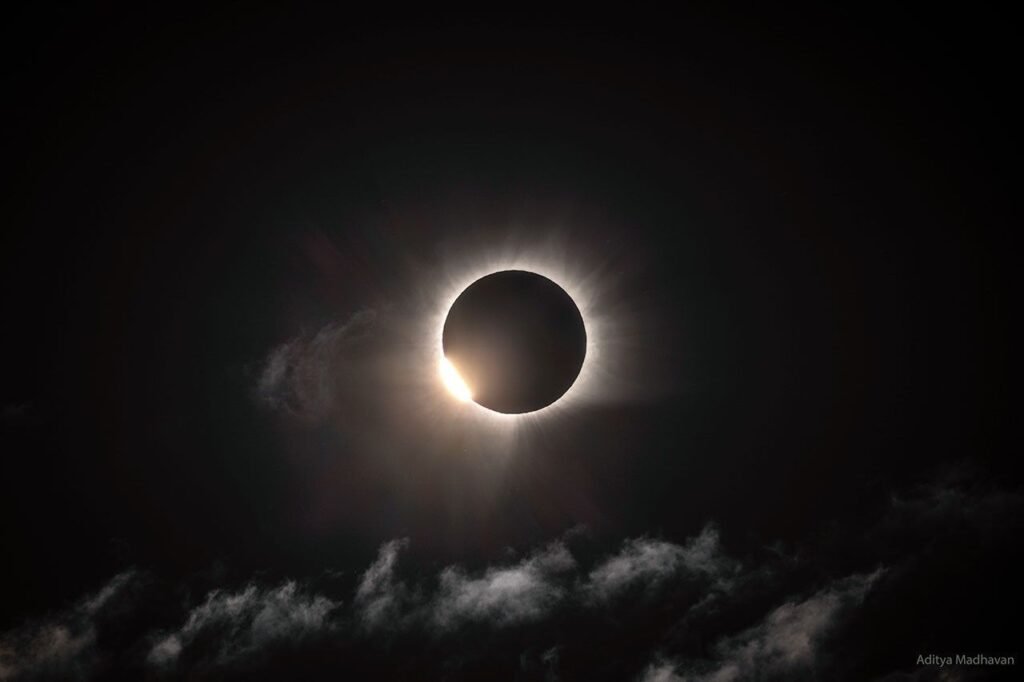
Because the image was taken near the initial edge of clearing weather along the track, it stands as one of the earliest clear visual records of the event. Atmospheric conditions varied considerably along the rest of the path as the shadow moved toward Southern Europe.