

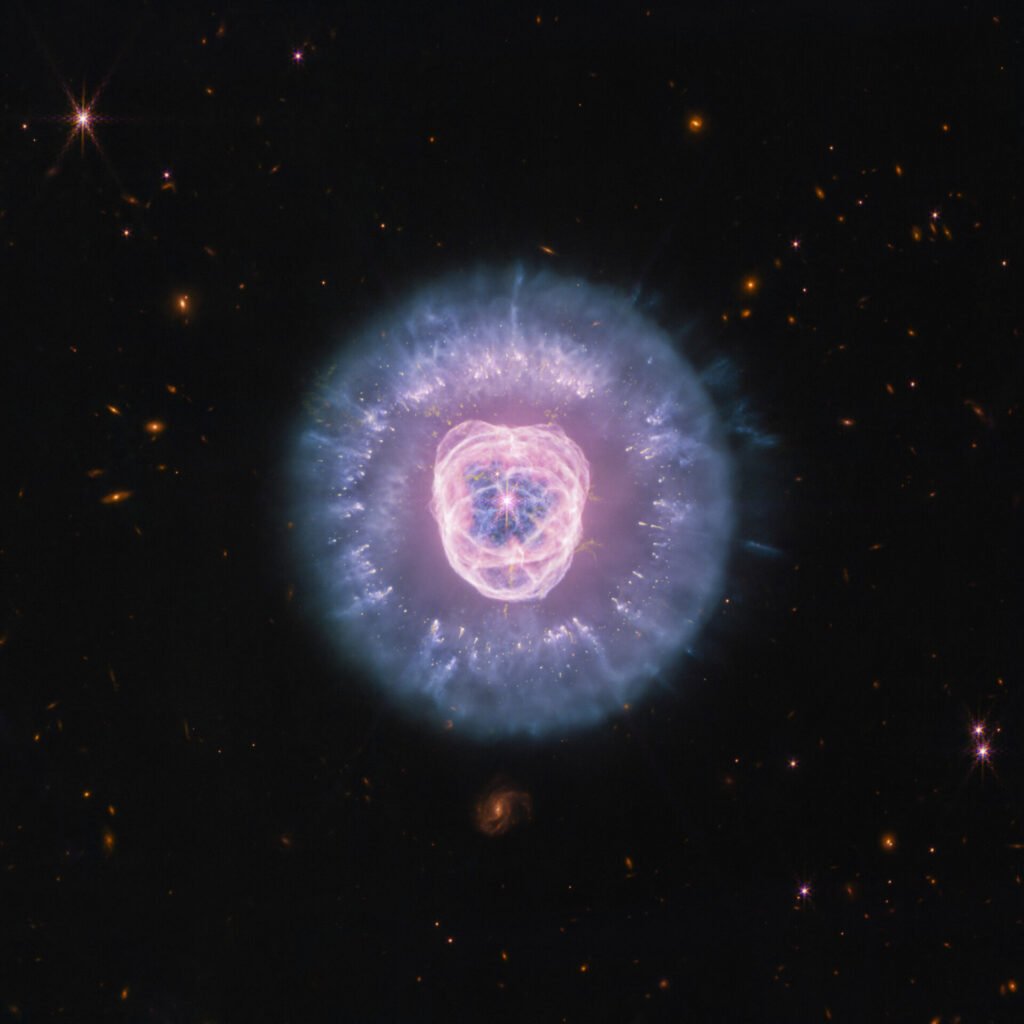
Lion Nebula observations by the James Webb Space Telescope have delivered a detailed look into the violent, beautiful demise of a distant star. Formally cataloged as NGC 2392, this planetary nebula earned its common moniker because its central structures and surrounding halo resemble the face and mane of a male lion. By examining the target in high-resolution infrared light, the observatory has uncovered physical details that were previously unseen in visible-light views.
A Remarkable Look into the Lion Nebula
Astronomers previously studied NGC 2392 in 2000 using the Hubble Space Telescope, which imaged its lion-like features in visible light. While Hubble clearly mapped the object’s broad facial outline and outer streaming material, Webb’s combined observations using its Near Infrared Camera (NIRCam) and Mid-Infrared Instrument (MIRI) provide much sharper clarity across infrared wavelengths.
Although the nebula’s broad geometry in Webb’s infrared imagery mirrors Hubble’s earlier findings, the new data reveals critical fine-scale structures. Webb’s infrared instruments penetrate surrounding gas to highlight compact dust knots and delicate hazes of ionised gas. These components have taken several thousand years to form and continue to be reshaped as material expands into surrounding space.
How the Central Star Shapes Cosmic Material
At the center of the structure lies a dying white dwarf star, positioned where the nose of the cosmic lion appears. Despite having already ejected its outer layers, the high-energy radiation from this central remnant continues to power the surrounding dynamic features.
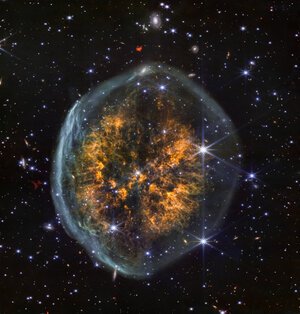
- Expanding gas bubble: Ionised gas inflates outward over time, carving through and destroying surrounding dust in its path.
- Concentric rings and shells: Swept-up material arranges itself into nested spherical structures around the central core.
- Illuminated dust mane: The outer mane consists of the inner edge of a dust shell lit up by radiation from the central white dwarf.
- Cometary dust tails: Dense clumps of dust manage to survive the intense radiation, casting protective shadows that create long, hair-like tendrils.
Unresolved Questions and Cosmic Timelines
Even with Webb’s detailed view, key questions about the formation of planetary nebulae remain unanswered. Researchers are still trying to determine why expanding gas forms such structured rings and shells, a phenomenon seen across many dying star systems.
Webb’s imaging effectively captures a single moment in an ongoing stellar transformation. As gas and dust gradually drift farther from the central white dwarf, the object will continue to evolve. Scientists calculate that the Lion Nebula will fully disperse into interstellar space in roughly 10,000 years, ending a brief chapter in cosmic history.